
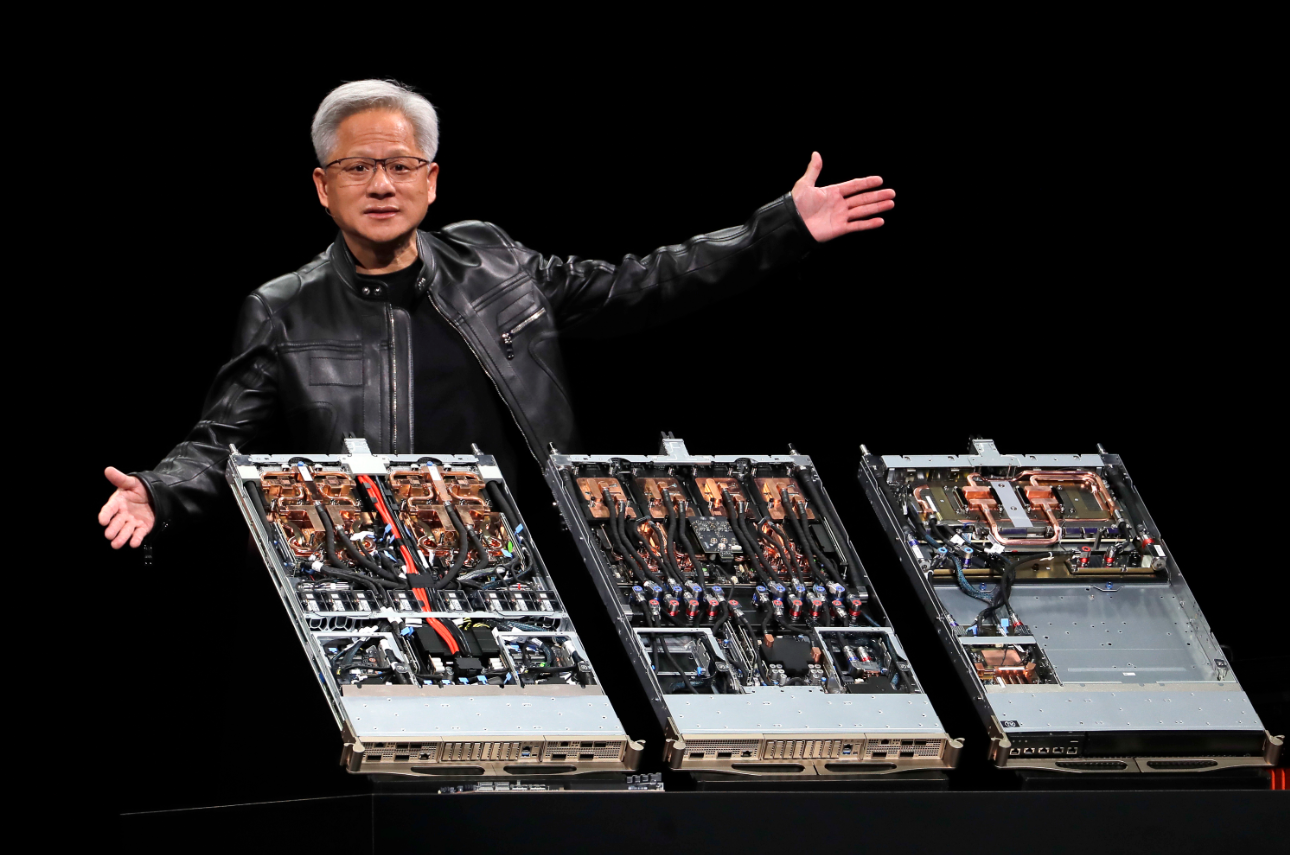
Nvidia is moving aggressively to secure its position as the world’s most powerful AI hardware company. In a high-stakes business move, Nvidia CEO Jensen Huang traveled to Taiwan in October to meet with executives of TSMC (Taiwan Semiconductor Manufacturing Company) — the world’s largest contract chip manufacturer and Nvidia’s most crucial production partner.
The purpose of the meeting was straightforward but critical: secure more wafer supply to ensure Nvidia can meet the exploding global demand for AI chips.
📌 Key Highlights
- Jensen Huang personally met TSMC leadership to secure additional wafer capacity.
- Nvidia expects AI chip demand to remain exceptionally strong in 2025 and beyond.
- Nvidia is currently the world’s most valuable company, valued at $4.69 trillion.
- The company aims to prevent competitors from capturing supply during a global AI boom.
- Nvidia’s platform strategy blends hardware, software, and services — reinforcing dominance in gaming, data centers & AI.
🌐 Why This Meeting Matters
The global demand for AI infrastructure is skyrocketing. Tech giants, cloud service providers, startups, and governments are racing to acquire Nvidia GPUs such as the H100, H200, Blackwell, and next-gen platforms.
Nvidia’s dominance relies heavily on TSMC’s cutting-edge chip manufacturing nodes.
But with AMD, Apple, Qualcomm, and dozens of AI startups also competing for TSMC production slots, securing wafer allocation has become a strategic battleground.
By flying to Taiwan personally, Huang sent a clear message:
👉 Nvidia will not risk losing chip supply during the AI revolution.
👉 The company is positioning itself for massive future growth.
🧠 Why AI Demand Is Surging
AI is driving one of the fastest technology transitions in history. Demand is fueled by:
✔️ Generative AI
Large language models (LLMs) and generative systems require massive GPU clusters.
✔️ Data Center Expansion
Cloud providers like AWS, Google Cloud, and Microsoft Azure are scaling GPU supercomputers globally.
✔️ AI in Every Industry
Healthcare, finance, defense, automotive, and robotics now rely on high-performance GPU computing.
✔️ Global Competition
Countries are racing to build AI sovereign infrastructure to reduce dependence on foreign technology.
🏭 Nvidia + TSMC: A Critical Partnership
TSMC manufactures Nvidia’s most advanced chips using 3nm and 5nm processes.
This partnership is vital because:
| Factor | Importance |
|---|---|
| TSMC capacity | Determines how many Nvidia GPUs can be produced |
| Advanced nodes | Required for cutting-edge AI performance |
| Competition | AMD, Apple & startups also fight for TSMC priority |
| Global supply chain fragility | Geopolitical risks increase urgency |
Huang’s visit likely focused on locking in long-term supply agreements for next-gen AI platforms.
📊 Nvidia’s Current Market Status
| Metric | Value (Nov 2025) |
|---|---|
| Market Cap | $4.69 trillion |
| Position | World’s most valuable company |
| Primary Demand | AI, data centers, generative AI, HPC |
| Core Manufacturing Partner | TSMC |
Nvidia’s explosive valuation is directly tied to the AI wave — and maintaining sufficient chip supply is essential to keep that momentum going.
🔧 Nvidia’s Strategy for AI Dominance
Nvidia has built a powerful platform ecosystem consisting of:
🔹 Hardware
GPUs (H100, H200, Blackwell), networking (InfiniBand), accelerators.
🔹 Software
CUDA, TensorRT, Omniverse, AI frameworks.
🔹 Services
Enterprise AI cloud, DGX Cloud, AI training solutions.
This complete ecosystem makes it extremely difficult for competitors to catch up.
🚀 Conclusion: Nvidia Is Preparing for an AI Mega-Cycle
Jensen Huang’s urgent mission to Taiwan clearly signals that AI is not slowing down — it is accelerating.
By securing more TSMC wafer capacity, Nvidia is:
- Protecting its supply chain
- Strengthening its global leadership
- Preparing for massive AI demand in 2025–2030
As AI reshapes every industry, Nvidia is ensuring it stays at the center of the future of computing.